Exam 3 Solutions
Rewrite each integral as an iterated integral:
\(\displaystyle\iint_R f(x,y)\;dA\)
where \(R\) is the rectangle \([1,3]\times[0,5]\).
SolutionHere \(1 \le x \le 3\) and \(0 \le y \le 5\). In this case, the order of the integration does not matter, as long as the limits correspond to the variables. Both
\[\int_1^3\int_0^5 f(x,y)\; dy\; dx\]
and
\[\int_0^5\int_1^3 f(x,y)\; dx\; dy\]
are correct.
\(\displaystyle\iint_R f(x,y)\;dA\)
where \(R\) is the region bounded by the curves \(y = x\) and \(y = x^2\).
SolutionThe region is shown in the following picture:
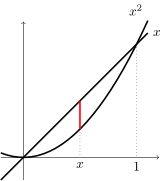
Slicing the region vertically, we see that \(0 \le x \le 1\) and \(x^2 \le y \le x\), so the integral will be
\[\int_0^1 \int_{x^2}^x f(x,y)\;dy\;dx\]
It is possible to slice this region horizontally, but you would end up with square roots in the limits:
\[\int_0^1 \int_{y}^{\sqrt{y}} f(x,y)\;dx\;dy\]
\(\displaystyle\iint_R f(x,y)\;dA\)
where \(R\) is the triangle with corners \((0,0)\), \((2,2)\) and \((5,0)\).
SolutionThe region is shown in the following picture:
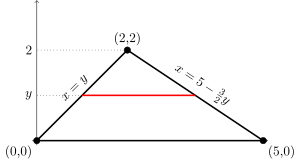
The region should be sliced horizontally, in order to avoid having to split it into two separate region. The lowest \(y\) is \(0\), the highest is \(2\), and \(y \le x \le 5 - \frac{3}{2}y\):
\[\int_0^2 \int_{y}^{5 - \frac{3}{2}y} f(x,y)\;dx\;dy\]
Calculate each iterated integral:
\(\displaystyle\int_0^1\int_0^\pi x^2\sin(y)\;dy\;dx\)
SolutionThis is an integral over a rectangular region of a function that can be written as \(f(x)g(y)\). This can be “de-coupled” in the following way:
\[ \begin{aligned} \int_0^1\int_0^\pi x^2\sin(y)\;dy\;dx &= \int_0^1 x^2\;dx \int_0^\pi \sin(y)\;dy\\ &= \left.\left(\frac{x^3}{3}\right)\right\rvert_0^1 \left.\left(-\cos(y)\right)\right\rvert_0^\pi\\ &= \left(\frac{3^3}{3} - 0\right)\left(-\cos(\pi) - (-\cos(0))\right)\\ &= (9 - 0)(1 - (-1)) = 18. \end{aligned} \]
\(\displaystyle\int_0^1\int_0^y e^{y^2}\;dx\;dy\)
Solution\[ \begin{aligned} \int_0^1\int_0^y e^{y^2}\;dx\;dy &= \int_0^1e^{y^2}\int_0^y \;dx\;dy\\ &= \int_0^1 e^{y^2} y\;dy \end{aligned} \]
Substitute \(u = y^2\), \(du = 2y\;dy\):
\[ \begin{aligned} \int_0^1 e^{y^2} y\;dy &= \frac{1}{2}\int_0^1 e^{y^2}\;2y\;dy\\ &= \frac{1}{2}\int_0^1 e^u\;du\\ &= \frac{1}{2}\left.\left(e^u\right)\right\rvert_0^1\\ &= \frac{1}{2}\left(e^1 - e^0\right)\\ &= \frac{e-1}{2}. \end{aligned} \]
(Extra credit) Four vector field plots and six vector fields are given. Match each plot with one of the vector fields:
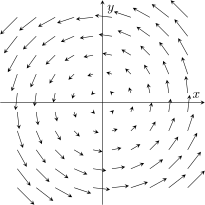
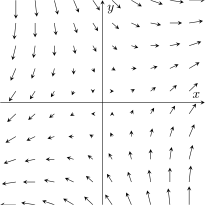
Vector field: c Vector field: b 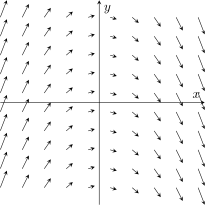
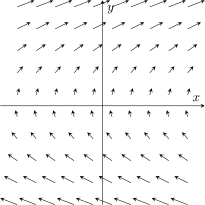
Vector field: f Vector field: d \(\mathbf{F}(x,y) = \left\langle xy,x+y\right\rangle\)
\(\mathbf{F}(x,y) = \left\langle x+y,x-y\right\rangle\)
\(\mathbf{F}(x,y) = \left\langle-y,x\right\rangle\)
\(\mathbf{F}(x,y) = \left\langle y,1\right\rangle\)
\(\mathbf{F}(x,y) = \left\langle-x,y\right\rangle\)
\(\mathbf{F}(x,y) = \left\langle 1,-x\right\rangle\)
(Extra credit) Four vector field plots are given. Some of them are gradient fields of some function of two variables, for some of them no such function exists. If a field is a gradient field of a function, one of its potential functions can be found on the list of six candidate potential functions below the plots.
For each field, find its potential function, or state that none exists.
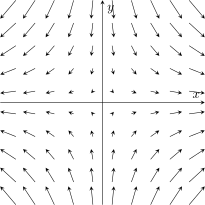
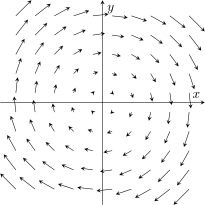
Function: d Function: none 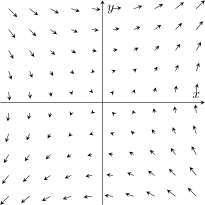
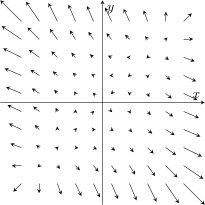
Function: a Function: b \(f(x,y) = xy\)
\(f(x,y) = x^4 + y^4 - 4xy\)
\(f(x,y) = \sin(y-1)\cos(x+1)\)
\(f(x,y) = x^2 - y^2\)
\(f(x,y) = x^3 + y^3 - 3xy\)
\(f(x,y) = 2x+5\)
Rewrite each of the given line integrals as a Riemann integral of a real function of a single real variable over an interval. Your answer should not use any vector notation. Do not evaluate the resulting integrals!
\(\displaystyle\int_C (x^2 - y) \;ds\) where \(C\) is the line segment connecting the points \((2,1)\) and \((1,4)\).
SolutionStart by finding a parametrization of the line segment. A line segment from point \(P\) to point \(Q\) has a vector equation \(r = \mathbf{P} + t\overrightarrow{PQ}\), where \(\mathbf{P}\) is the position vector of the point \(P\), which is \(\left\langle 2,1\right\rangle\), and \(\overrightarrow{PQ}\) is the vector from \(P\) to \(Q\), in this case \(\left\langle -1, 3\right\rangle\). This gives us the parametrization
\[r(t) = \left\langle 2,1\right\rangle + t\left\langle -1, 3\right\rangle = \left\langle 2 - t, 1 + 3t\right\rangle\]
where \(0 \le t \le 1\).
Then \(r'(t) = \left\langle -1, 3\right\rangle\). Substituting
\[ \begin{aligned} x &= 2 - t\\ y &= 1 + 3t\\ ds &= \left\lVert r'(t)\right\rVert\;dt = \sqrt{(-1)^2 + 3^2}\;dt = \sqrt{10}\;dt \end{aligned} \]
will give us
\[\int_0^1 \left((2-t)^2 - (1 + 3t)\right)\sqrt{10}\;dt = \sqrt{10}\int_0^1 (3 - 7t + t^2)\;dt\]
\(\displaystyle\int_C x^2y \; dy\) where \(C\) is the curve parametrized by \(\mathbf{r}(t) = \left\langle\cos(t), \sin(5t)\right\rangle\) for \(0\le t \le \pi\).
SolutionWe are substituting
\[ \begin{aligned} x &= \cos(t)\\ y &= \sin(5t)\\ dy &= y'(t)\;dt = 5\cos(5t)\;dt \end{aligned} \]
to get
\[\int_0^\pi \cos^2(t)\sin(5t)5\cos(5t)\;dt\]
\(\displaystyle\int_C \mathbf{F}\cdot d\mathbf{r}\) where \(\mathbf{F}(x,y) = y^2\mathbf{i} + x\mathbf{j}\) and \(\mathbf{r}(t) = (1+t) \mathbf{i} + t^2\mathbf{j}\), \(0 \le t \le 2\).
SolutionWe are substituting
\[ \begin{aligned} x &= 1 + t\\ y &= t^2\\ d\mathbf{r} &= \mathbf{r}'(t)\;dt = \left(\mathbf{i} + 2t\mathbf{j}\right)\;dt \end{aligned} \]
to get
\[\int_0^2 \left(\left(t^2\right)^2\mathbf{i} + (1+t)\mathbf{j}\right)\cdot \left(\mathbf{i} + 2t\mathbf{j}\right)\;dt\]
This is not finished yet, since it uses vector notation. To get the desired answer, we need to simplify the dot product:
\[\int_0^2 t^4 + 2(1+t)t\;dt\]
Find out whether the following fields are conservative. Show all relevant work!
\(\mathbf{F}(x,y) = \left\langle xy^3 + 2x^3y, 3x^2y - y^2\right\rangle\)
SolutionThe components of the vector field are
\[ \begin{aligned} P(x,y) &= xy^3 + 2x^3y\\ Q(x,y) &= 3x^2y - y^2 \end{aligned} \]
Then
\[\frac{\partial Q}{\partial x}(x,y) = 6xy\]
and
\[\frac{\partial P}{\partial y} = 3xy^2 + 2x^3.\]
Since these are not equal, the field is not conservative.
\(\mathbf{F}(x,y) = (9x^2y^2 - y^4)\mathbf{i} + (6x^3y - 4xy^3)\mathbf{j}\)
SolutionThe components of the vector field are
\[ \begin{aligned} P(x,y) &= 9x^2y^2 - y^4\\ Q(x,y) &= 6x^3y - 4xy^3 \end{aligned} \]
Then
\[\frac{\partial Q}{\partial x}(x,y) = 18x^2y - 4y^3\]
and
\[\frac{\partial P}{\partial y} = 18x^2y - 4y^3\]
Since these are equal, and all the partial derivatives of \(P\) and \(Q\) are continuous, the field is conservative.
(Extra credit) \(\mathbf{F}(x,y,z) = \left\langle yz^2 - 2xz, xz^2, 2xyz - x^2\right\rangle\)
SolutionFirst calculate \(\operatorname{curl}\mathbf{F}\):
\[\operatorname{curl}\mathbf{F} = \mathbf{\nabla}\times\mathbf{F} = \begin{vmatrix} \mathbf{i} & \mathbf{j} & \mathbf{k}\\ \frac{\partial}{\partial x} & \frac{\partial}{\partial y} & \frac{\partial}{\partial z}\\ yz^2 - 2xz & xz^2 & 2xyz - x^2 \end{vmatrix} = 0\mathbf{i} + 0\mathbf{j} + 0\mathbf{k} \]
Since \(\operatorname{curl}\mathbf{F} = \mathbf{0}\) and all the components have continuous derivatives, the vector field is conservative.
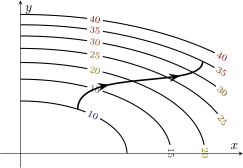
The figure shows a curve \(C\) with arrows indicating direction, and a contour map of a function \(f\) whose gradient is continuous. Find \(\int_C \nabla f\cdot d\mathbf{r}\).
 Solution
According to the Fundamental Theorem of Calculus for Line Integrals,
\[\int_C \mathbf{\nabla} f\cdot d\mathbf{r} = f(\text{end of $C$}) - f(\text{start of $C$}) = 35 - 10 = 25.\]
The plot below shows a vector field \(\mathbf{F}(x,y)\) and a curve \(C\) with orientation as indicated by arrows.
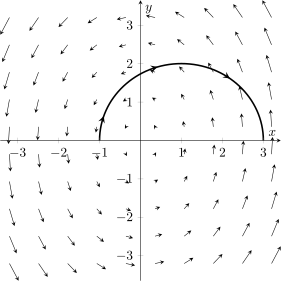
Determine whether \(\int_C \mathbf{F}\cdot d\mathbf{r}\) is positive, negative or zero. Explain your reasoning.
SolutionNegative
Explanation:
SolutionThe arrows on the curve indicating the orientation go against the arrows of the vector field throughout the whole length of the curve.
Given a conservative vector field \(\mathbf{F}(x,y) = (y^3 - 4xy + 1)\mathbf{i} + (3xy^2 - 2x^2 - 2y)\mathbf{j}\),
Find \(f(x,y)\) such that \(\mathbf{F} = \mathbf{\nabla} f\).
SolutionWe know that
\[ \begin{aligned} f_x(x,y) &= y^3 - 4xy + 1\\ f_y(x,y) &= 3xy^2 - 2x^2 - 2y \end{aligned} \]
Then
\[f(x,y) = \int y^3 - 4xy + 1\;dx = xy^3 - 2x^2y + x + C(y).\]
Taking the derivative with respect to \(y\) gives us
\[f_y(x,y) = 3xy^2 - 2x^2 + C'(y).\]
Comparing this with \(3xy^2 - 2x^2 - 2y\), we see that \(C'(y) = -2y\), or \(C(y) = -\int 2y\;dy = -y^2 + C\).
\[f(x,y) = xy^3 - 2x^2y + x + C(y) = xy^3 - 2x^2y + x - y^2 + C.\]
(Extra credit) Calculate
\[\int_C \mathbf{F}\cdot d\mathbf{r}\] where \(C\) is given by the vector function \(\mathbf{r}(t) = (2t+1)\mathbf{i} - (t^2 - t - 1)\mathbf{j}\) for \(0 \le t \le 1\).
SolutionAccording to the Fundamental Theorem of Calculus for Line Integrals, if \(\mathbf{F}\) is a conservative vector field with potential function \(f\), then
\[\int_C \mathbf{F}\cdot d\mathbf{r} = f(\text{end of $C$}) - f(\text{start of $C$}).\]
In the previous problem we found out that a potential function of \(\mathbf{F}\) is
\[f(x,y) = xy^3 - 2x^2y + x - y^2.\]
The starting point of \(C\) has position vector \(r(0) = \mathbf{i} + \mathbf{j}\), so the starting point is \((1,1)\).
The ending point of \(C\) has position vector \(r(1) = 3\mathbf{i} + \mathbf{j}\), so the ending point is \((3,1)\).
Therefore
\[\int_C \mathbf{F}\cdot d\mathbf{r} = f(3,1) - f(1,1) = -13 - (-1) = -12\]
Find the following line integral:
\[\oint_C \nabla f(x,y) \cdot d\mathbf{r}\] where \(f(x,y) = 7x^2 + 2xy^2 +y\) and the curve \(C\) is the positively oriented circle with radius 3 and center at the point \((2,-1)\). (If it is taking you more than few seconds to answer this question, you are doing something wrong!)
SolutionA line integral of a conservative vector field over a closed curve is always \(0\).
Use the Green’s Theorem to rewrite the integral
\[\oint_C (x^2y + \cos(x))\;dx + (2xy - \sin(y))\;dy\] where \(C\) is the path starting at \((0,0)\), going in the straight line segment to \((1,1)\), then in a line segment to \((0,1)\), and finally in a line segment back to \((0,0)\), as a double integral of a scalar function of two variables over a region in \(\mathbb{R}^2\). Rewrite the double integral as an iterated integral, but do not evaluate it.
SolutionThe closed curve \(C\) is as follows:
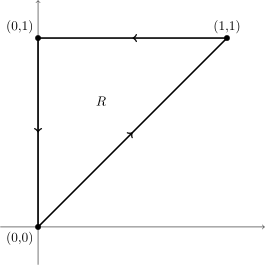
According to the Green’s Theorem,
\[\oint_C \mathbf{F}\cdot d\mathbf{r} = \iint_R \frac{\partial Q}{\partial x} - \frac{\partial P}{\partial y}\;dA\]
Here
\[\oint_C (x^2y + \cos(x))\;dx + (2xy - \sin(y))\;dy = \iint_R 2y - x^2\;dA\]
To rewrite the double integral as an iterated integral, we can either slice the region vertically to get
\[\int_0^1 \int_x^1 2y - x^2\;dy\;dx\]
or horizontally to get
\[\int_0^1 \int_0^y 2y - x^2\;dx\;dy\]
Rewrite the surface integral \[\iint_S \mathbf{F}\cdot d\mathbf{S}\] as a double integral of a function of two variables over a region in \(\mathbb{R}^2\), where \(\mathbf{F} = (x+y)\mathbf{i} + (x-y)\mathbf{j} + z\mathbf{k}\) and the surface is given by the parametric equations \(x = u + v\), \(y = u - v\) and \(z = uv\), for \(0\le u \le 1\) and \(0 \le v \le 1\), with upwards orientation. Your answer should be an iterated integral with limits, with no vector notation. Do not evaluate the resulting integral!
SolutionWe need to substitute
\[ \begin{aligned} x &= u + v\\ y &= u - v\\ z &= uv\\ d\mathbf{S} &= \frac{\partial \mathbf{r}}{\partial u}\times\frac{\partial\mathbf{r}}{\partial v}\;dA \end{aligned} \]
where \(\mathbf{r}(u,v) = \left\langle u+v, u-v, uv\right\rangle\).
\[\frac{\partial \mathbf{r}}{\partial u}\times\frac{\partial\mathbf{r}}{\partial v} = \begin{vmatrix} \mathbf{i} & \mathbf{j} & \mathbf{k}\\ 1 & 1 & v\\ 1 & -1 & u \end{vmatrix} = (u+v)\mathbf{i} + (v - u)\mathbf{j} - 2\mathbf{k}.\]
However, this gives us a downwards orientation, since the \(\mathbf{k}\) component is negative, so we will need to use
\[d\mathrm{S} = \left(-(u+v)\mathbf{i} - (v - u)\mathbf{j} + 2\mathbf{k}\right)\;dA.\]
Substituting into \(\mathbf{F}\) gives us
\[\mathbf{F}(u,v) = (u + v + u - v)\mathbf{i} + (u + v - u + v)\mathbf{j} + (u+v)(u-v)\mathbf{k} = 2u\mathbf{i} + 2v\mathbf{j} + (u^2 - v^2)\mathbf{k}\]
Altogether we get
\[\int_0^1\int_0^1 \left(2u\mathbf{i} + 2v\mathbf{j} + (u^2 - v^2)\mathbf{k}\right)\cdot \left(-(u+v)\mathbf{i} - (v - u)\mathbf{j} + 2\mathbf{k}\right)\;du\;dv,\]
and, after calculating the dot product, we get
\[\int_0^1\int_0^1 \left(-2u(u+v) + 2v(u-v) + 2(u^2 - v^2)\right)\;du\;dv = -4\int_0^1\int_0^1v^2\;du\;dv\]
The surface \(S\) is defined by the vector equation \(\mathbf{r}(u,v) = \left\langle u^2 + v, u^2 - v, uv\right\rangle\) for \(0 \le u \le 2\) and \(0 \le v \le 3\).
Find a normal vector to the surface at the point where \(u = 2\) and \(v = 1\).
SolutionA normal vector to \(S\) is given by
\[\frac{\partial\mathbf{r}}{\partial u}\times\frac{\mathbf{r}}{\partial v} = \begin{vmatrix} \mathbf{i} & \mathbf{j} & \mathbf{k}\\ 2u & 2u & v\\ 1 & -1 & v \end{vmatrix} = (2uv + v)\mathbf{i} - (2uv - v)\mathbf{j} - 4u\mathbf{k}\]
At \(u = 2\), \(v = 1\), we get
\[5\mathbf{i} - 3\mathbf{k} - 8\mathbf{k}\]
or any nonzero scalar multiple.
(Extra credit) Find an equation of the tangent plane to the surface at that point.
SolutionFor a plane, we need a normal vector and a point. We already have a normal vector \(\left\langle 5, -3, -8\right\rangle\). To get a point on the plane, evaluate
\[\mathbf{r}(2,1) = \left\langle 2^2 + 1, 2^2 - 1, 2\cdot 1\right\rangle = \left\langle 5, 3, 2\right\rangle\]
The plane through the point with position vector \(\left\langle 5, 3, 2\right\rangle\) with a normal vector \(\left\langle 5, -3, -8\right\rangle\) has equation
\[\left\langle 5,-3,-8\right\rangle \cdot \left\langle x, y, z\right\rangle = \left\langle 5,-3,-8\right\rangle \cdot \left\langle 5, 3, 2\right\rangle\]
which will simplify as
\[5x - 3y - 8z = 25 - 9 - 16\]
or
\[5x - 3y - 8z = 0.\]
Given the vector field \(\mathbf{F} = xz\mathbf{i} + yz\mathbf{j} - xy\mathbf{k}\)
Find the curl and divergence of the field.
Solution\[\operatorname{curl}\mathbf{F} = \mathbf{\nabla}\times\mathbf{F} = \begin{vmatrix} \mathbf{i} & \mathbf{j} & \mathbf{k} \\ \frac{\partial}{\partial x} & \frac{\partial}{\partial y} & \frac{\partial}{\partial z}\\ xz & yz & -xy \end{vmatrix} = (-x - y)\mathbf{i} + (x + y)\mathbf{j} + 0\mathbf{k}\]
and
\[\operatorname{div}\mathbf{F} = \mathbf{\nabla}\cdot\mathbf{F} = z + z + 0 = 2z\]
(Extra credit) Give an example of a point at which \(\mathbf{F}(s,y,z)\) expands.
SolutionAny point where \(\operatorname{div}\mathbf{F} > 0\), in other words, any point where \(z\) is positive.
(Extra credit) Give an example of a point at which \(\mathbf{F}(s,y,z)\) contracts.
SolutionAny point where \(\operatorname{div}\mathbf{F} < 0\), in other words, any point where \(z\) is negative.